


Slow cranking, rapid clicking, and lights that fade during starting are common signs of a dead car battery. You may turn the key or press the button and get very little response, even though the radio still works. That can happen because the starter needs much more current than those smaller accessories.
What drivers call a “dead battery” can mean two different things. A flat battery may recover after suitable charging, while a worn-out one may struggle to start the car even when charged. Poor connections or a charging fault can cause similar trouble, so a no-start does not automatically mean you need a new battery.
Signs of a dead car battery include slow or absent cranking, rapid clicking, and lights that fade during a start attempt. The radio may still work because it needs much less current than the starter. A jump-start does not prove the battery needs replacing, so have the battery, connections, and charging system checked as appropriate. Do not jump-start or charge a damaged or suspected frozen battery.
Key Takeaways
- A discharged battery may recover after suitable charging; a failed battery needs replacement.
- Working lights do not prove there is enough power to crank the engine.
- A battery-shaped light while driving often points to a charging-system problem.
- Find out why the battery keeps going flat instead of relying on repeated jump-starts.
- Voltage helps assess charge, but a suitable battery-health test checks starting performance.
7 Signs of a Dead Car Battery
This guide covers conventional 12-volt lead-acid starting batteries in gasoline and diesel vehicles. Hybrids and EVs may also have a low-voltage battery, but they can behave differently when it loses power. Never use these checks on the high-voltage battery that drives the vehicle.
1. The Engine Turns Over Slowly
Listen for a slower, more labored sound than you normally hear when starting. The starter is still turning the engine, but it sounds as though it is struggling. A weak or undercharged battery can cause this, particularly when cold weather makes starting harder.
The battery is not the only possible cause. Cables, connections, and the starter itself can also be involved. When you describe the problem, say whether the engine turns slowly or turns at its normal speed but will not fire, because those symptoms call for different checks.
2. You Hear Rapid Clicking Instead of Cranking
A quick series of clicks often means available power is dropping during the start attempt. The battery may be low, or a poor connection may be limiting current to the starter. Stop trying repeatedly and note whether the dashboard fades at the same time.
One solid click gives you less to go on. Battery, cable, starter, and starter-solenoid faults can sound similar, so the click alone cannot identify the failed part. Tell the service provider whether you heard a single click or a repeated series.
3. The Lights Fade or the Dashboard Resets During Starting
You may notice the dashboard flicker, go dim, or reset as you try to start. A little dimming can be normal, so compare it with what your car usually does. A much larger drop in electrical power can point to low charge, battery deterioration, or a poor connection.
It is easy to rule out the battery when the radio and cabin lights still work. Those features need far less current than the starter, though. The battery may still be unable to crank the engine, even with enough power left for the accessories.
4. There Is Little or No Electrical Response
If the dashboard stays dark and several electrical features do not respond, a heavily discharged battery is one possibility. A disconnected cable, damaged main connection, or fuse fault can look much the same. The lack of response does not mean the battery has zero volts or has permanently failed.
Look at whether the whole car seems powerless or only one feature has stopped working. If the remote will not unlock the doors, for example, the key fob may have its own problem. Check the manual’s backup entry and starting instructions before assuming the car battery is responsible.
5. The Car Repeatedly Needs a Jump-Start
A car that needs a jump after a light was left on is different from one that needs help every morning. Repeated discharge may come from a worn battery, inadequate charging, or something that keeps using power while the car is parked. You may hear that last problem described as a parasitic drain.
The battery’s age is worth knowing, but it cannot explain the fault on its own. Our guide to how long car batteries last covers the effects of heat, driving habits, and storage. A newer battery can go flat too, while an older one needs to be assessed by condition as well as age.
6. The Battery or Its Connections Look Abnormal
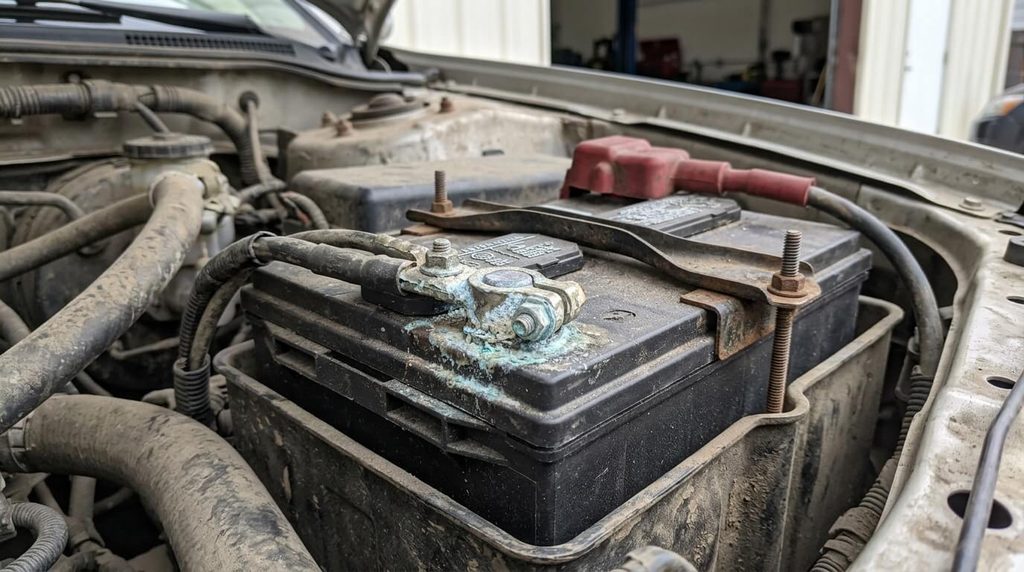
White, blue, or greenish buildup around a terminal can interfere with the connection. That is a reason to have the connection checked, not proof that the battery’s cells have failed. Loose or damaged cables also need attention, even if a battery-health test comes back good.
A swollen, cracked, or leaking battery is a different matter. Stop attempts to start or charge it if you see damage, notice unusual heat, or detect a strong sulfur-like smell around it. Do not lean closer to investigate the smell or touch anything that may have leaked.
7. The Battery Warning Light Stays On While Driving
Seeing the battery symbol before you start the engine may simply be part of the normal warning-light check. It needs attention if it stays on after starting or appears while you are driving. Even if the symbol is on, the problem may be in the charging system rather than inside the battery.
If charging stops, the car can eventually use up its available battery power, as the charging-system warning-light explanation describes. There is no dependable distance you can assume it will keep running. Reach a safe stopping place, check the manual’s instructions for that warning, and arrange assistance.
Stop if the battery is swollen, cracked, leaking, unusually hot, or suspected to be frozen. Keep flames and sparks away, and have a qualified service provider assess it. If there is smoke, fire, or an immediate danger, move away from the vehicle and contact emergency services.
Dead Battery vs. Bad Alternator: What Is Different?
In a conventional gasoline car, the battery provides the power to start the engine. Once the engine is running, the alternator supports the electrical loads and replenishes battery charge. A charging failure can therefore leave the battery flat even when the battery was not the original fault.
The timing can help narrow things down. Tell the technician whether the problem happens before starting, while driving, or after the car has been parked. The familiar shortcut of “runs after a jump means battery, stalls after a jump means alternator” is too simple to diagnose either part.
| What You Notice | Possible Explanation | What to Check Next |
|---|---|---|
| Slow crank or rapid clicks before starting | Low charge, weak battery, or poor connection | Battery condition and cable connections |
| Battery light while the engine runs | Charging-system fault | Alternator, drive system, wiring, and controls |
| Starts with a jump, then goes flat again while parked | Battery deterioration, parked drain, or insufficient charge | Charge and health test, then drain diagnosis if needed |
| Single click with no cranking | Battery, cable, starter, or solenoid problem | Battery, cables, and starter operation |
| Normal cranking but the engine will not fire | Fuel, ignition, security, or another engine-control issue | Fuel, ignition, security, and engine controls |
Do not disconnect a battery cable while the engine is running to see whether the car keeps going. The alternator testing precautions warn that this can damage vehicle electronics. Have the charging system tested properly instead.
How to Check Without Guessing at the Fault
If you are beside traffic, getting help comes before looking under the hood. Only attempt a visual inspection when the vehicle is safely parked, and you have a safe place to stand. Leave checks involving inaccessible batteries, unfamiliar connections, or moving engine parts to a service provider.
- Record the symptom. Note slow cranking, clicks, no electrical response, or normal cranking without starting.
- Check what happened beforehand. Mention lights left on, extended parking, recent repairs, cold weather, or earlier jump-starts.
- Look for visible hazards. Stop for damage, leakage, unusual heat, or suspected freezing. Do not remove covers or reach terminals you cannot safely access.
- Arrange charging and testing as appropriate. A discharged battery may need suitable charging before its health can be assessed, provided it is safe to charge.
- Follow up on the cause. If the battery passes but symptoms continue, check the charging system, connections, starter, or parked electrical drain.
What a Voltage Reading Can Tell You
A resting reading around 12.6 volts suggests a high state of charge for many conventional 12-volt lead-acid starting batteries. It is a guide, not a universal pass mark. Battery design, temperature, recent charging, and electrical loads affect the reading, and low-voltage lithium batteries need their own reference values.
A battery can show a normal-looking voltage and still struggle to start the engine. The battery-testing explanation separates the amount of charge present from the battery’s ability to perform. A suitable conductance or load test helps assess that ability when it is selected and interpreted for the battery’s type and condition.
Ask the person testing it to explain the result. “Charge and retest” does not mean the battery has been confirmed faulty, and the tester needs the correct battery type and rating. If the battery passes but the car still struggles to start, there is more to investigate.
What Are the Signs of a Dead Cell in a Car Battery?
A failed cell can make starting unreliable. The battery may struggle to hold charge, or a suitable tester may recommend replacement. You cannot identify the cell fault from the sound alone, because other problems can produce the same symptoms.
A useful clue appears in the battery fault guidance: a properly charged 12-volt battery reading roughly 10.45 to 10.65 volts probably has a shorted or dead cell. A reading near 10.5 volts during cranking or on a deeply discharged battery does not prove the same thing. Do not open a sealed battery or keep trying to charge it to establish the diagnosis yourself.
Should You Charge, Jump-Start, or Replace It?
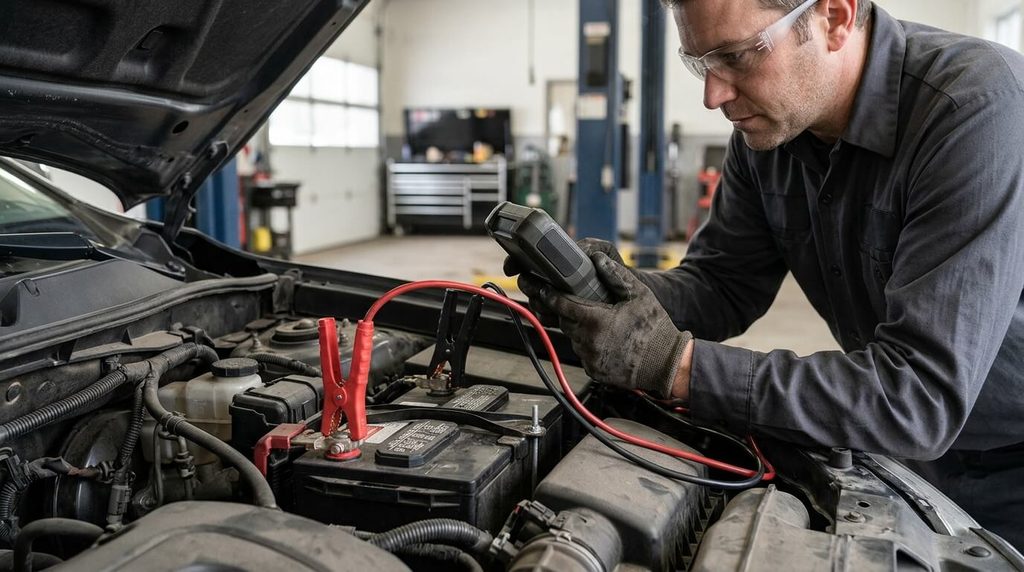
If the battery went flat because a light was left on, suitable charging and a health test may be all it needs, provided it is safe to charge. A battery that fails proper testing will not recover its lost performance through another jump-start. Our guide to how often to replace a car battery explains how condition and test results help make that decision.
Before a jump-start, check that the vehicle and equipment instructions allow it and that the battery is safe to jump. Use the specified connection points rather than assuming you should attach leads to whichever terminals you can see. If warnings remain, the engine stalls, or you still do not know why it went flat, arrange further help.
Getting the engine running does not mean the battery is fully charged. The battery-charging FAQs explain why the depth of discharge, charging time, and alternator operating conditions matter. Ask about suitable charging and another test instead of relying on a fixed number of minutes behind the wheel.
Conclusion
The signs of a dead car battery help you describe the problem and decide what to check next. Slow cranking, rapid clicks, and fading lights suggest trouble delivering starting power. Normal cranking without firing, or a charging warning while driving, points to a different set of checks.
Have the battery charged and tested when appropriate, and stop trying if it appears damaged or unsafe. If it passes, keep looking at the connections, charging system, or an unexplained drain. Knowing why the car won’t start helps you avoid needing another jump tomorrow.
Frequently Asked Questions
Can the lights work if the car battery is dead?
Yes, a battery can have enough available power for lights but not enough to operate the starter. Drivers often call that a dead battery even though it is not completely without charge. Connections and starter faults can also cause a no-crank, so working lights do not settle the diagnosis.
Does a successful jump-start prove the battery is bad?
No, it shows that outside assistance helped the car start. The battery may be discharged, deteriorated, or affected by another fault. Check its health and why it lost charge before deciding on replacement.
Can a car battery fail without warning?
Yes, some failures occur without a noticeable change in starting beforehand. Other batteries give clues such as slower cranking or repeated discharge. A lack of symptoms does not guarantee that an aging battery will remain reliable.
Does a failed jump-start mean the battery needs replacing?
No, a failed attempt does not prove the battery needs replacing. The jump equipment, its connections, or another fault may be the reason the car will not start. Stop repeated attempts, check the instructions and safety conditions, and arrange roadside testing if needed.

